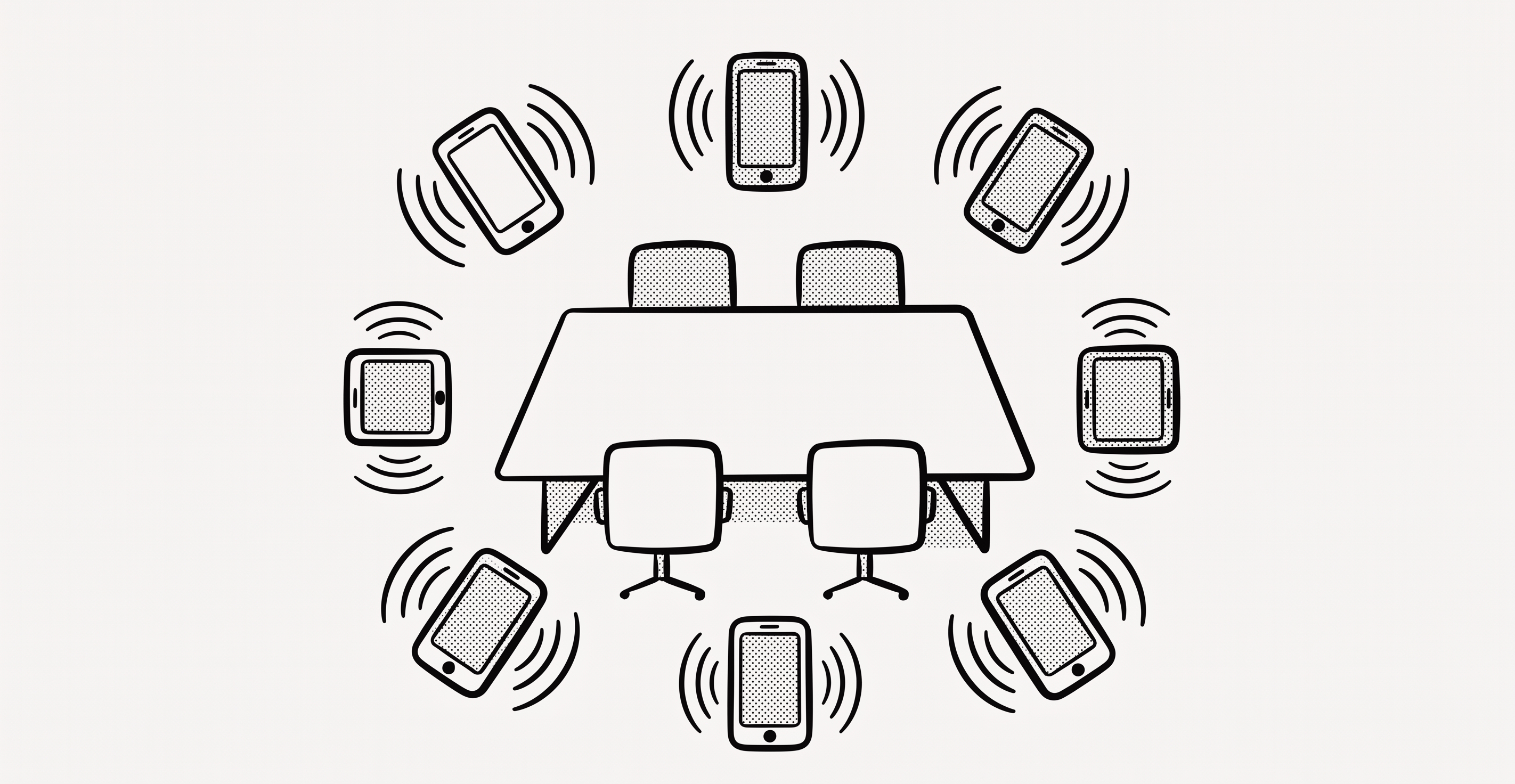
You can tell a lot about a team's meeting culture by watching where people's eyes go in the first five minutes. If they are on their phones or flicking between apps on their laptops, the meeting has already lost. Not because the people do not care, but because they have learned through experience that the risk of missing something in their notification feed is higher than the cost of being half-present in the meeting.
The cost of a distracted meeting
A distracted meeting costs more than just the time in the room. When people are monitoring their notifications during a meeting, two things happen simultaneously: they miss information from the meeting and they process information from their notifications in a shallow, interrupted way.
Neither the meeting nor the notification gets full attention. The meeting produces lower-quality decisions because input was partial. The notification gets a response that is hurried, context-free, and often sends a follow-up thread into motion that will demand more attention later.
The downstream cost is a Slack conversation that re-litigates the decision made in the meeting, this time asynchronously, involving people who were physically in the room but not really there. Research from Atlassian found that unclear decisions from meetings cost teams an average of three hours per week in re-clarification.
Add the pre-meeting and post-meeting time that gets eaten by notification backlog management, and a one-hour meeting can easily consume two hours of productive capacity.
How distracted are your meetings?
Before you try to fix your meeting culture, get an honest read on where you are starting from.
What to do before the meeting
The distraction problem in meetings starts before the meeting begins. People arrive at meetings mid-scroll: they were just checking Slack, and they have not finished processing what was there.
Two minutes before a meeting is not enough time to close the loop on a complex notification thread. So people carry it into the meeting with them. They are physically present but cognitively still in the conversation they just left.
The most effective pre-meeting change is a brief notification clearance ritual. Give your team two to five minutes before any meeting to clear their inbox: read everything that came in, decide what can wait and what needs a quick response, and then close the apps. With a unified notification tool like Notico, this clearance takes two minutes because there is one feed to scan rather than three or four separate ones.
Send a brief agenda at least 24 hours before any recurring meeting. Not a long document. Three bullet points: what the meeting is for, what decisions need to be made, and what information people need to read beforehand. This reduces the amount of catching-up that happens in the room, which is one of the primary reasons people feel they need to stay connected to their notification feeds during a meeting.
What to do during the meeting
State the norm at the start of the meeting, not as a rule but as a request: "let us put phones away for this one. Everything else will be there in an hour." This language works better than a policy because it treats the people in the room as adults rather than students.
The first few minutes of a meeting are when phones come out most. People are waiting for the meeting to start, or they are in the catching-up phase. Put the first substantive agenda item first, not announcements or housekeeping. When the meeting starts with something that requires engagement, people put the phone down.
Assign a note-taker for each meeting and make it clear that a summary goes out within an hour. When people know that decisions will be documented and shared, they no longer need to record them in real-time on their own devices. This removes one of the legitimate reasons people keep their phones visible: they are trying to remember what was decided.
For longer meetings, build in a five-minute break every 50 minutes specifically designated as a notification check. "You have five minutes to check Slack and email. Let us pick back up at 2:35." This works better than trying to ban notifications for 90 minutes, because people are less anxious about what they are missing when they know a check is coming.
The follow-up that locks it in
A meeting with clear decisions and a prompt summary produces far less notification noise than one without. When people know what was decided, they do not need to clarify in Slack. When they have a record they can reference, they do not need to send a message asking someone to repeat what was agreed.
Send the decision summary within one hour of the meeting ending. Keep it short: a bullet point per decision, who owns what, and any deadlines. This one habit reduces the post-meeting Slack thread by more than any in-room phone policy.
The second step is to review the meeting norm periodically. A norm that worked well when your team was five people may not work for a team of twelve. Ask your team every quarter whether the meeting norms are serving them, and adjust based on what you hear.
The broader point is that focused meetings are not about eliminating phones. They are about creating a context where the meeting is worth being present for. That requires a clear agenda, decisions that matter, and a follow-up that respects the time people invested. When meetings are worth attending, people attend.
Notico makes pre-meeting notification clearance fast.
Instead of scanning three separate apps before a meeting, your team scans one feed and sees only what actually needs a response. Two minutes and it is done. Free during early access.
Get Notico for your teamSources: Atlassian State of Teams Report (2023); Harvard Business Review "Stop the Meeting Madness" (2017); Microsoft WorkLab research on meeting engagement and phone use; American Psychological Association on task-switching costs.