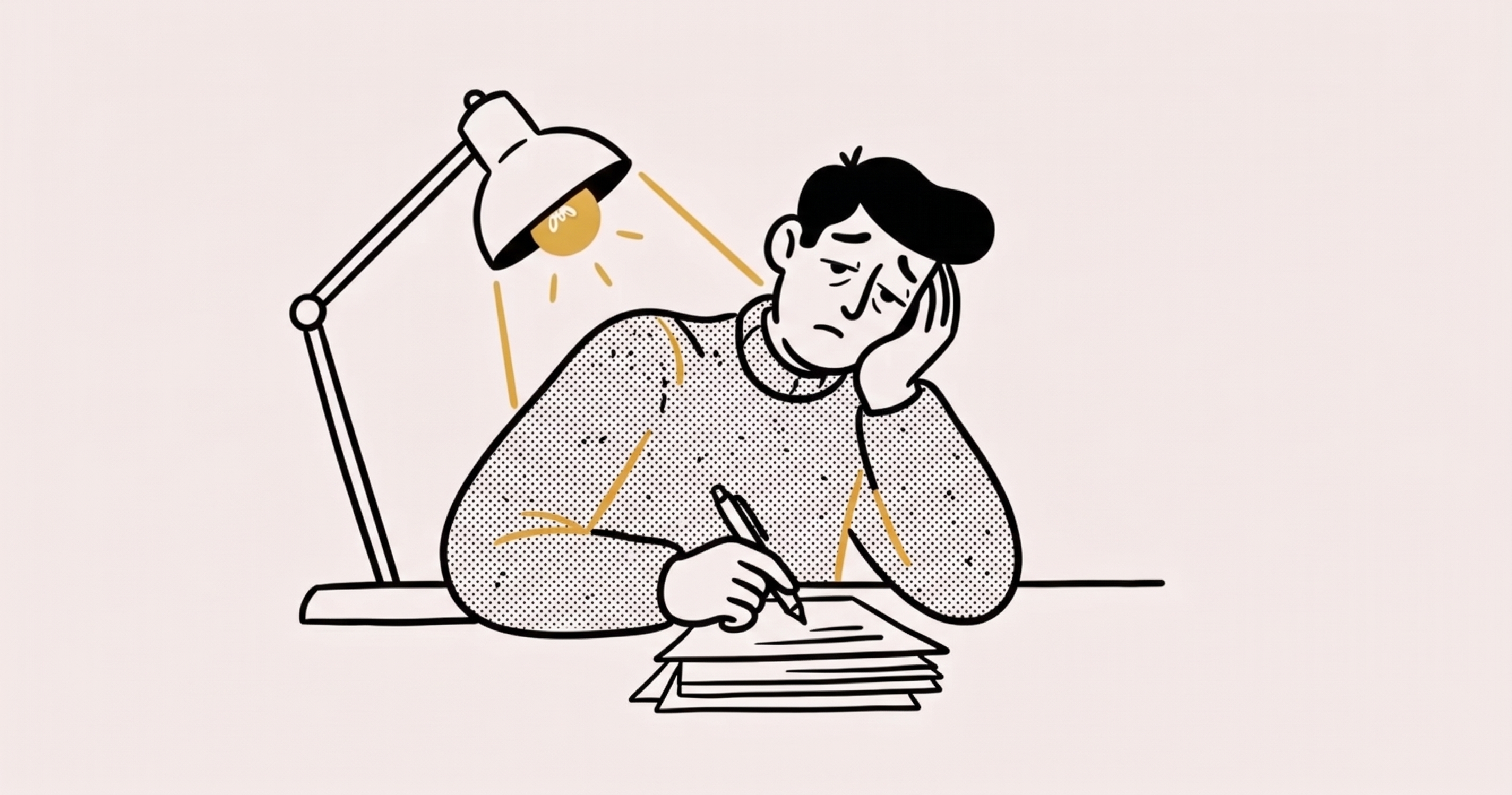
Burnout does not usually arrive with a clear cause. It accumulates. One too many evenings checking Slack. One more week where the work that actually mattered got pushed to Friday afternoon. One more performance review where someone who seemed fine was not fine at all. If you are a manager trying to understand why your team's energy is dropping, the notification environment is one of the first places to look.
The notification-burnout link
Burnout has three recognised components: emotional exhaustion, depersonalisation, and reduced personal accomplishment. Notification overload contributes to all three.
Emotional exhaustion grows when people spend their days in a state of interrupted attention. Every notification is a minor stressor. A minor stressor resolved quickly is nothing. A minor stressor arriving every four minutes across an eight-hour day is a significant cognitive load that leaves people depleted by 3pm even when nothing difficult happened.
Depersonalisation, the detachment from work and colleagues, develops when people feel that the work is endless and reactive rather than purposeful. When your day is defined by what came in rather than what you set out to do, it is hard to feel that the work means anything.
Reduced personal accomplishment comes from the output gap: the difference between how much a person was active and how much they actually produced. A person who spent eight hours in reactive mode and produced very little has a harder time pointing to what they achieved, even if they were never idle.
The notification environment is not the only driver of burnout. But it is one that managers can directly influence, and one that is often overlooked in favour of other explanations.
Run the burnout diagnostic
Use the tool below to assess your team's current notification risk. Be honest about each statement.
Warning signs to watch for
Before burnout is reportable in an engagement survey, it shows up in behaviour patterns. These are the earliest signals that notification overload is becoming a wellbeing issue.
Response speed creep: the informal expectation of response time has gotten shorter over time, often without anyone deciding it should. People are checking messages more frequently and feeling more anxious when they do not.
Output without achievement: your team is busy but the things on the roadmap are not moving. The work is happening but it is reactive work rather than the planned work. People feel like they are always behind even when they are always working.
Meeting avoidance: people who used to be engaged in meetings are becoming quieter or requesting to skip them. This is often a sign of cognitive overload, not disengagement. They are protecting a small amount of time where the notifications stop.
Late message patterns: you start noticing Slack messages being sent by team members after 8pm or before 7am. This is not ambition. This is people trying to find the only time of day when the notification stream is quiet enough to think.
PTO that does not restore: team members return from time off and are depleted again within two or three days. This is a structural problem. The work environment they returned to is the same one that depleted them. Rest without structural change is only a short-term fix.
The always-on culture problem
The deepest driver of notification-related burnout is not any single tool. It is the culture of availability that notifications enforce.
In an always-on culture, the implicit expectation is that people are reachable during all working hours and should respond quickly. This expectation is rarely stated explicitly. It is communicated through the manager's own response patterns, through the team's norms around message timing, and through what happens when someone does not respond quickly.
The problem with an always-on culture is that it is incompatible with deep work. Deep work requires blocking time when you are not available. An always-on expectation makes that impossible without social cost.
Managers create always-on cultures without intending to. The most common mechanism is manager response speed. When a manager replies to a message within two minutes at 9pm, the team learns that managers are available at 9pm. When a manager expects a reply and sends a follow-up after 20 minutes, the team learns that 20 minutes is too long.
Breaking this culture requires two things: an explicit statement of what is not expected, and consistent manager behaviour that models it. The statement alone is insufficient. If you announce that people do not need to respond to messages after 6pm and then you send them a follow-up at 8pm asking for a response, the statement is worthless.
What managers can do now
Three changes will have the highest impact on reducing notification-driven burnout risk in your team.
First, set and model response time norms. Define an explicit window, something like "two hours during business hours for non-urgent messages" and then follow it yourself. When you send a message, use your platform's scheduled send feature to queue it for business hours rather than sending it in real time at 9pm.
Second, create and protect team focus blocks. Two hours in the morning where meetings are not scheduled and the expectation is that people are unavailable unless there is a genuine emergency. This is the most structurally important change because it gives people permission to do the work rather than just manage the stream.
Third, separate urgent from normal. Define a clear escalation path for genuine emergencies so that people can trust that if something is truly urgent, it will reach them through a specific channel. This permission structure, knowing that real emergencies have their own path, is what allows people to stop monitoring every channel all the time.
A unified notification tool like Notico supports all three of these. When the team is using one feed that surfaces urgent signals and holds non-urgent ones, the monitoring pressure drops without the risk of missing something that matters.
Notico gives your team one feed instead of five inboxes to monitor.
When your team routes Slack, Gmail, Outlook and Asana into Notico, they see what actually needs attention without the constant monitoring that builds up into burnout. Free during early access.
Get Notico for your teamSources: Deloitte Global Millennial and Gen Z Survey (2022); Slack Workforce Index (2023); Gallup State of the Global Workplace (2022); Gloria Mark, UC Irvine, research on digital interruption and cognitive load; Christina Maslach, Burnout: The Cost of Caring (1982, research updated through 2023).