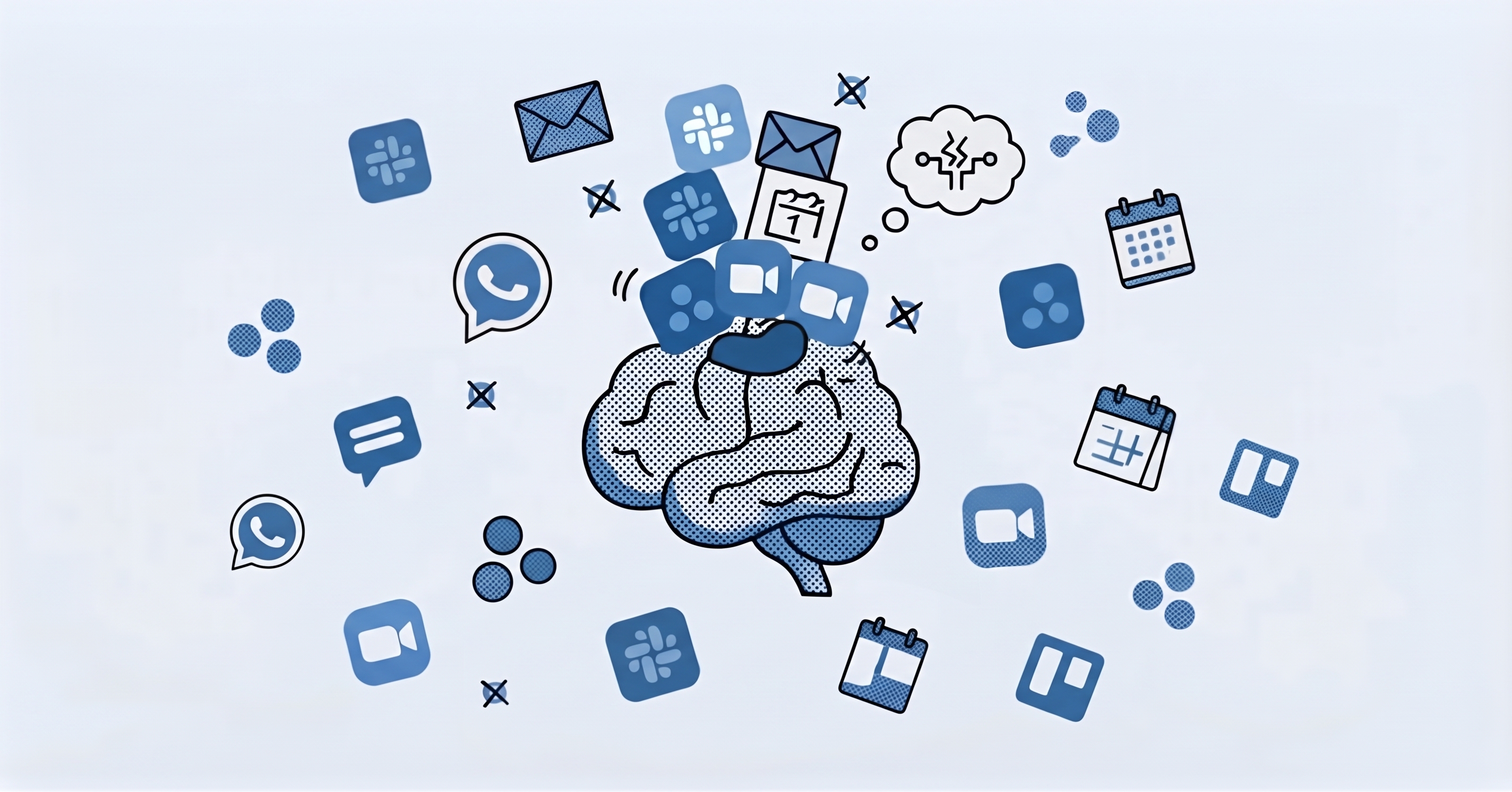
The average knowledge worker has 8 to 10 apps open simultaneously during the workday. Slack, Gmail, a project tool, a browser with 12 tabs, a design tool, a spreadsheet, a calendar and a communication platform that does not quite fit any category. The assumption is that this is fine. That modern brains are adapted to it. They are not.
The actual problem with 8 simultaneous apps
Working memory, the part of your brain that holds and manipulates information actively, has a capacity of roughly 2 to 4 items at once. This is not a metaphor. It is a hard limit documented across decades of cognitive neuroscience research, most thoroughly by George Miller in his 1956 paper and refined extensively since.
When you have 8 apps open, each making potential demands on your attention, you are not working with 8 things at once. You are cycling through them at a speed that feels like parallelism but is actually very rapid serial switching. And each switch carries a cost that does not show up on any dashboard.
The cost is called the task-switching penalty. Every time your brain shifts from one context to another, it must de-activate the neural patterns relevant to the previous task and activate the patterns relevant to the new one. This takes time, roughly 100 to 150 milliseconds per switch at the fastest end, and it consumes the prefrontal cortex resources that would otherwise go toward actual thinking.
Check your cognitive load right now
Before going further, use the tool below to get a rough estimate of your current cognitive load based on your working environment today.
What the neuroscience actually says
The prefrontal cortex is the part of the brain responsible for planning, decision-making, working memory and what researchers call "executive function." It is also the part of the brain most affected by notification load, and it is remarkably easy to saturate.
A study from the University of California, Irvine found that after an interruption, it takes an average of 23 minutes and 15 seconds for a person to return to the same depth of cognitive engagement they had before the interruption. This is not about the time it takes to read the notification. It is about the time it takes for the prefrontal cortex to re-establish the neural activation patterns required for the original task.
Average time for the prefrontal cortex to return to full engagement on a task after a single interruption. With 8 apps competing for your attention, you are never recovering.Source: Gloria Mark, UC Irvine
The deeper issue is what researchers call "residual activation." When your brain switches away from a task, it does not cleanly close that context. The previous task leaves a residual pattern of activation that interferes with full engagement on the new one. With 8 apps open, you are accumulating residual activation from multiple previous contexts simultaneously. The result is that no single task ever gets your full prefrontal capacity.
The switching tax your brain pays
The American Psychological Association has described this phenomenon as "the switching costs." They identify two components: the "goal reconfiguration" cost (your brain deciding what to focus on) and the "rule activation" cost (your brain loading the relevant knowledge, tools and context for that task).
For simple tasks like responding to a Slack message, the switching cost is negligible. For complex tasks like writing, coding, analysis or strategic thinking, the switching cost can be substantial. When complex work is regularly interrupted by notifications, the effective time available for deep cognitive work drops far below what the clock suggests.
Harvard Business Review quantified this in a 2022 study: knowledge workers lose nearly 4 hours per week purely to the overhead of switching between applications. This is not lost to meetings, email or Slack messages. It is lost to the neurological cost of moving between contexts.
What actually works: structural reduction
The research consistently points to one solution: reduce the number of attention channels, not the time spent on each one. Having 8 apps open for 1 hour each is more damaging to output than having 2 apps open for 4 hours each, because the switching penalty compounds.
The most effective structural fix is a unified notification layer: a single place that aggregates what is happening across all your tools so your brain has one thing to monitor instead of eight. When you check one feed instead of switching between eight apps, you eliminate most of the switching penalty while still staying informed.
This is what Notico does. One unified inbox for Slack, Gmail, Outlook and Asana, with AI prioritisation that tells you what needs your attention before you open any of them. Your brain goes from monitoring 8 channels to monitoring 1. The switching tax drops. The real cost of context switching stops compounding.
Reduce your cognitive load to one feed.
Notico reads across Slack, Gmail, Asana and Outlook and shows you what actually needs your attention. Your brain monitors one thing instead of eight. Free during early access.
Join the waitlist freeThe willpower approach to this problem, trying harder to focus, closing apps manually, using website blockers, is fighting the wrong battle. The problem is not discipline. It is the structural mismatch between how your prefrontal cortex works and the environment most knowledge workers have built around themselves. Changing the environment works. Trying harder does not.
Sources: George A. Miller, "The Magical Number Seven, Plus or Minus Two" (1956); Gloria Mark, UC Irvine research on interruption and recovery; Harvard Business Review, "How Much Time and Energy Do We Waste Toggling Between Applications" (2022); American Psychological Association, "Multitasking: Switching costs" (2006).